

The world is facing a growing water crisis, with an increasing demand for fresh water due to population growth, industrialization, and climate change. Desalination, the process of removing salt and other impurities from seawater or brackish water, has emerged as a viable solution to meet this demand. Meanwhile, seawater electrolysers have been a subject of interest in various industries for their ability to produce chemicals and energy from seawater. This raises an important question: Can a seawater electrolyser be used in desalination plants? As a seawater electrolyser supplier, I will explore this topic in detail.
Understanding Seawater Electrolysis
Seawater electrolysis is a process that uses an electric current to split water molecules in seawater into hydrogen and oxygen gases. Additionally, in the presence of chloride ions in seawater, chlorine can also be produced through the electrolysis of sodium chloride (NaCl). This process occurs in an electrolyser, which consists of an anode and a cathode separated by an electrolyte.

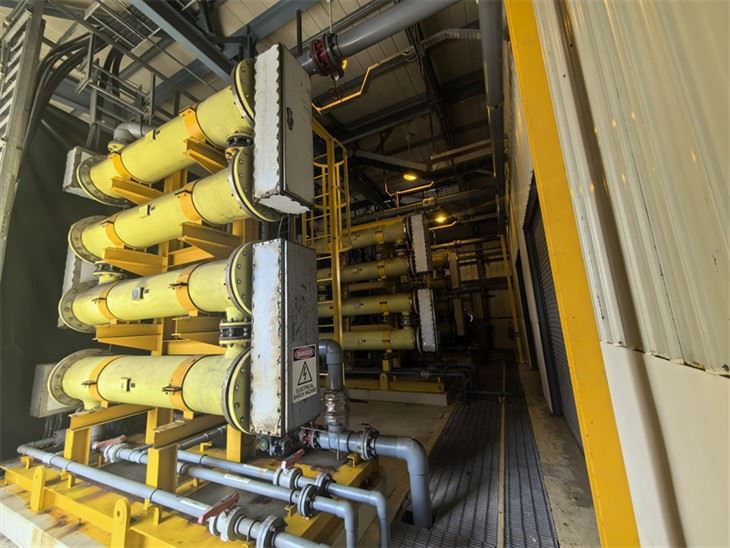
When an electric current is applied, at the anode, chloride ions are oxidized to form chlorine gas (Cl₂), and water molecules are also oxidized to produce oxygen gas (O₂). At the cathode, water molecules are reduced to form hydrogen gas (H₂) and hydroxide ions (OH⁻). The overall reactions can be simplified as follows:
Anode: 2Cl⁻ → Cl₂ + 2e⁻; 2H₂O → O₂ + 4H⁺ + 4e⁻
Cathode: 2H₂O + 2e⁻ → H₂ + 2OH⁻
Seawater electrolysers have several potential applications. For example, the produced hydrogen can be used as a clean energy source, and the chlorine can be used for disinfection purposes. There are different types of seawater electrolysers, such as proton exchange membrane (PEM) electrolysers and alkaline electrolysers, each with its own advantages and limitations.
Desalination Processes and Their Challenges
Desalination plants use various processes to remove salt and other impurities from seawater. The two most common methods are reverse osmosis (RO) and multi - stage flash distillation (MSF).
Reverse osmosis is a membrane - based process. Seawater is forced through a semi - permeable membrane under high pressure, allowing water molecules to pass through while retaining salt and other solutes. This method is energy - efficient compared to some other desalination methods and has a relatively low environmental impact. However, it requires pre - treatment of seawater to prevent membrane fouling and scaling, and the membranes need to be replaced periodically.
Multi - stage flash distillation, on the other hand, involves heating seawater and then flashing it into steam in multiple stages at successively lower pressures. The steam is then condensed to obtain fresh water. This process is well - established and can handle large volumes of seawater. But it is energy - intensive, mainly due to the high heat requirements for evaporation.
Both processes face challenges. Energy consumption is a major issue, as desalination requires a significant amount of power, which often comes from fossil fuels, contributing to greenhouse gas emissions. Additionally, the disposal of brine, the concentrated salt solution left after desalination, can have negative environmental impacts on marine ecosystems.
Potential Benefits of Using Seawater Electrolyser in Desalination Plants
1. Energy Production and Integration
One of the significant benefits of using a seawater electrolyser in a desalination plant is the potential for energy production. The hydrogen gas produced during seawater electrolysis can be used as a fuel. It can be burned directly to generate heat or used in fuel cells to produce electricity. This on - site energy production can reduce the desalination plant's dependence on external energy sources, especially fossil fuels. For example, in a desalination plant with an integrated seawater electrolyser, the produced hydrogen can power the high - pressure pumps used in reverse osmosis or the heating systems in multi - stage flash distillation.
2. Chemical Production for Water Treatment
The chlorine produced by the seawater electrolyser can be used for disinfection and water treatment within the desalination plant. Chlorine is a widely used disinfectant that can kill bacteria, viruses, and other microorganisms in seawater. In a desalination plant, it can be used in the pre - treatment stage to prevent biological fouling of membranes in reverse osmosis or to disinfect the final product water. This reduces the need to transport and store external chemical disinfectants, which can be costly and pose safety risks. You can learn more about the Salt Water Electro Chlorination System and Seawater Electro Chlorination System for more details on related chlorination technologies.
3. Brine Management
The concentrated brine from desalination plants can be a significant environmental concern. However, seawater electrolysers can potentially help in brine management. The high - salt content in the brine can be further processed in the electrolyser. The electrolysis of the brine can not only produce more chlorine and hydrogen but also reduce the salt concentration to some extent before disposal. This can mitigate the negative impact of brine on the marine environment.
Technical and Economic Considerations
1. Technical Compatibility
Integrating a seawater electrolyser into a desalination plant requires careful consideration of technical compatibility. The operating conditions of the electrolyser, such as temperature, pressure, and electrolyte composition, need to be compatible with the desalination process. For example, in a reverse osmosis desalination plant, the pre - treated seawater may have a different composition compared to raw seawater, which may affect the performance of the electrolyser. Additionally, the electrical power requirements of the electrolyser need to be coordinated with the power supply and demand of the desalination plant.
2. Economic Feasibility
The economic feasibility of using a seawater electrolyser in a desalination plant is also a crucial factor. The initial investment in the electrolyser system, including equipment purchase, installation, and commissioning, can be significant. However, the long - term savings from reduced energy costs and chemical procurement need to be evaluated. For example, if the cost of producing hydrogen on - site is lower than the cost of purchasing electricity from the grid, it can provide economic benefits over time. The market value of the by - products, such as hydrogen and chlorine, also needs to be considered. If there is a demand for these products in the local market, they can generate additional revenue for the desalination plant.
Case Studies and Research Progress
There have been several research projects and pilot studies exploring the integration of seawater electrolysers in desalination plants. Some research institutions have conducted laboratory - scale experiments to demonstrate the technical feasibility of using the produced hydrogen and chlorine in desalination processes. For example, a pilot project in a coastal area showed that by integrating a small - scale seawater electrolyser with a reverse osmosis desalination unit, the energy consumption of the desalination process was reduced by a certain percentage, and the quality of the product water was improved due to better disinfection.
In some regions, there are also commercial - scale attempts. A desalination plant in a water - scarce country is considering installing a large - scale seawater electrolyser system to improve its energy efficiency and water treatment capabilities. These case studies and research progress provide valuable insights into the practical application of seawater electrolysers in desalination plants.
Conclusion
In conclusion, the use of a seawater electrolyser in desalination plants has significant potential. It offers benefits in terms of energy production, chemical production for water treatment, and brine management. However, there are also technical and economic challenges that need to be addressed. As a seawater electrolyser supplier, I believe that with further research and development, and continuous improvement in technology, the integration of seawater electrolysers in desalination plants can become a more common and viable solution.
If you are interested in exploring the possibility of using our seawater electrolysers in your desalination plant, I encourage you to contact us for more information and to start a procurement negotiation. We are committed to providing high - quality seawater electrolyser solutions and working with you to address the global water challenge.
References
- Elimelech, M., & Phillip, W. A. (2011). The future of seawater desalination: energy, technology, and the environment. Science, 333(6043), 712 - 717.
- Bard, A. J., & Faulkner, L. R. (2001). Electrochemical methods: fundamentals and applications. Wiley.
- Lattemann, S., & Höpner, T. (2008). Environmental impact and impact assessment of seawater desalination. Desalination, 220(1 - 3), 1 - 15.